Within Manitoba UFOs
Why Did Charlie Red Star Grip Manitoba?
The Charlie Red Star wave turned repeated lights over southern Manitoba into a shared local mystery and Cold War-era legend.
On this page
- The 1975 76 sighting wave
- Carman, Pembina Valley and sky watching
- Ordinary lights, rumours and memory
Page outline Jump by section
Introduction
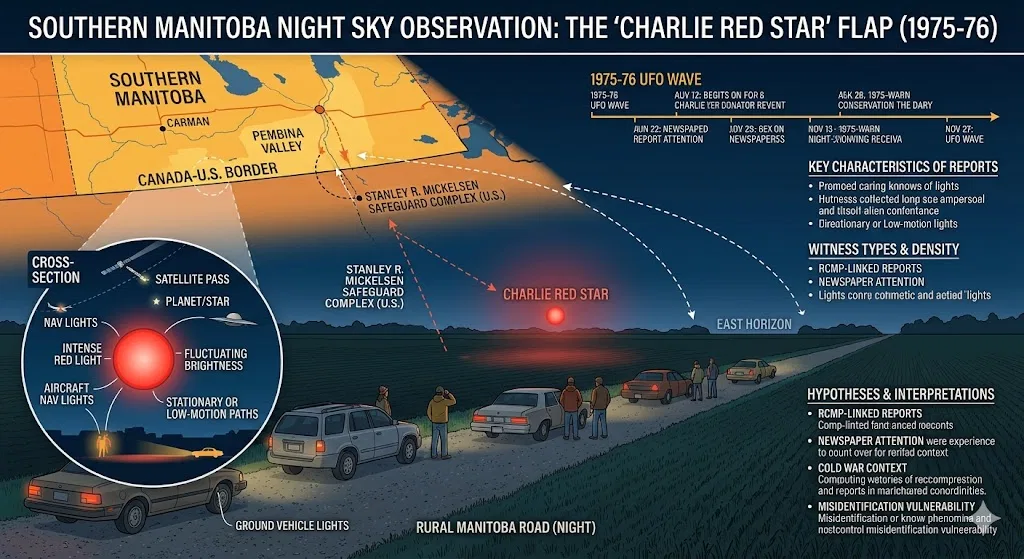
Charlie Red Star was the nickname given to a recurring red light, or cluster of lights, reported over southern Manitoba during the 1975-76 UFO wave, especially around Carman and the Pembina Valley. The story matters because it was not a single dramatic encounter like Falcon Lake. It was a local flap: repeated sightings, repeat witnesses, sky-watching trips, RCMP-linked reports, newspaper attention, photographs of uncertain value and a shared rural mystery that became part of Manitoba’s UFO folklore. The strongest evidence is not a recovered object or a decisive official conclusion. It is the density of reports, the local consistency of the “red light” motif and the way the sightings entered Canadian UFO archives and later research. The main weakness is just as important: repeated lights seen at night are vulnerable to misidentification, rumour, expectation and memory, especially once a community starts watching the sky together.[Chris Rutkowski+2Dundurn]chrisrutkowski.substack.comChris Rutkowski50 Years Ago: Canada's "Summer of UFOs.Chris Rutkowski50 Years Ago: Canada's "Summer of UFOs.
The 1975-76 sighting wave
The Charlie Red Star flap sits inside a wider Canadian UFO wave in 1975. Chris Rutkowski, a Manitoba-based UFO researcher who has worked extensively with Canadian case files, describes that summer as a period when “hundreds” of odd-object reports reached the National Research Council of Canada, the RCMP and other agencies. In his summary of the year, he notes 134 Manitoba cases in the Ufology Research database for 1975 alone, while placing those cases within more than 2,000 pages of Canadian documentation from that year.[Chris Rutkowski]chrisrutkowski.substack.comChris Rutkowski50 Years Ago: Canada's "Summer of UFOs.Chris Rutkowski50 Years Ago: Canada's "Summer of UFOs.
The Carman-area sequence became distinctive because one recurring object seemed to acquire a personality. On 10 April 1975, Bob and Elaine Diemert reportedly saw a red light flying low near their airfield outside Carman. Rutkowski identifies this as the first of many sightings of “Charlie Redstar”, the name attached to the red ball of light said to haunt the area through the spring and summer. Later entries in the same 1975 summary place additional Manitoba reports at Beaconia on 4 June, Winnipeg on 4 July and Carman again on 7 July, when Mrs Freddie Giesbrecht reported a UFO east of her farmhouse to the RCMP.[Chris Rutkowski]chrisrutkowski.substack.comChris Rutkowski50 Years Ago: Canada's "Summer of UFOs.Chris Rutkowski50 Years Ago: Canada's "Summer of UFOs.
Grant Cameron’s book-length treatment, published by Dundurn in 2017, presents the wave as one of North America’s largest UFO sighting episodes, with reports continuing “well over a year” and one object repeatedly seen under the Charlie Red Star name. Cameron’s position is unusual because he was not only a later writer on the case: the publisher’s summary states that he witnessed Charlie Red Star many times and led tours for others to see it. That makes his account valuable as a participant-observer source, but also one that should be read with awareness that it comes from inside the UFO research community rather than from a detached official investigation.[Dundurn]dundurn.comCharlie Red StarCharlie Red Star - Dundurn…
The pattern, then, is best understood as a case family rather than a single event. “Charlie Red Star” did not refer to one verified craft tracked across a fixed route. It became a label for a set of southern Manitoba observations that witnesses and later storytellers connected because they seemed similar: red lights, repeated appearances, low or unusual motion, and a strong concentration around Carman and nearby rural communities.[charlieredstar.com]charlieredstar.comOpen source on charlieredstar.com.

Carman, the Pembina Valley and the habit of sky-watching
Carman gave the flap its centre of gravity. The town sits in southern Manitoba, in open agricultural country where long horizons, dark roads and farm airstrips made night-sky watching both easy and socially visible. That geography helped turn scattered reports into a local pastime. Dundurn’s page for Cameron’s book quotes a review describing the Pembina Valley scene as a period when people were “racing down backroads” trying to track down UFOs, a telling detail because it shows how the sightings moved from private observation into public local behaviour.[Dundurn]dundurn.comCharlie Red StarCharlie Red Star - Dundurn…
The Diemert airfield story is important for the same reason. A private airfield outside Carman was a natural gathering point for people trying to watch the sky, compare sightings and decide whether a light was an aircraft, a planet, farm equipment or something stranger. Once a repeated light had a name, the act of looking for it became part of the phenomenon. People were no longer only reporting unexpected lights; they were going out hoping to see Charlie.
That does not make the witnesses foolish or dishonest. It does make the evidence more complicated. A group of people watching the same sky after hearing the same stories may converge on a shared interpretation, especially when the object is distant, bright and seen at night. A red light that might otherwise have been logged as “unknown light in the south-west” could become “Charlie” because the community already had a name, a narrative and a set of expectations.
At the same time, the repetition cannot simply be waved away. The Carman-area reports were not all vague second-hand rumours. They included named local witnesses, reports to police, media attention and later archival interest. A Blue Book Archive listing from Grant Cameron’s files, for example, includes a 52-page “Canada Charlie Red Star” document with OCR text referring to RCMP interest in photographs said to be connected with the case. That is not proof of an extraordinary object, but it does show the episode left documentary traces beyond campfire retellings.[Project Blue Book Archive]bluebookfiles.orgProject Blue Book Archive Canada Charlie Red Star 6 (unknownProject Blue Book ArchiveCanada Charlie Red Star 6 (unknown) - Blue Book Archive…
Why official records help but do not settle the case
Canadian UFO reporting in the 1970s did not run through a single permanent UFO office. Library and Archives Canada says its UFO collection was built from records acquired from the Department of National Defence, Department of Transport, National Research Council and RCMP, with about 9,500 digitised documents from 1947 to the early 1980s. The collection includes correspondence, reports, memos and procedures, but many records are partial, undated or difficult to search by place and date.[Canada]canada.cas UFOs: The search for the unknownCanada's UFOs: The search for the unknown - Canada.ca…
That matters for Charlie Red Star because readers often assume that “the government investigated it” means there should be one clean verdict. The Canadian record was messier. The Office of the Chief Science Advisor’s Sky Canada Project explains that, from 1967 until 1995, the National Research Council became the main federal body receiving UFO reports, with files collated by the Herzberg Institute of Astrophysics under “non-meteoritic sightings”. It also notes that RCMP and other police forces could receive reports, especially where public safety was involved, but the RCMP generally did not have a dedicated UAP policy or specialist classification system.[Science.gc.ca]science.gc.caManagement of Public Reporting of Unidentified Aerial Phenomena in CanadaManagement of Public Reporting of Unidentified Aerial Phenomena in Canada
For the Charlie Red Star flap, this means official involvement should be read cautiously. A report to the RCMP, or an RCMP officer witnessing a light, can strengthen the historical record that something was reported and taken seriously enough to note. It does not automatically identify the object. Police records often preserve time, place, witness details and immediate observations; they do not necessarily provide astronomical, aviation or radar analysis.
The same caution applies to photographs and media footage. The case is often described as having eyewitnesses, photographers and reporters chasing the story. That breadth makes the flap culturally important, but night photographs of lights are notoriously difficult to interpret without reliable exposure data, direction, lens information, comparison stars, weather and independent tracking. In other words, a photograph can prove that a light was recorded without proving what the light was.

Ordinary lights, Cold War rumours and the missile-site question
The most plausible explanations for individual Charlie Red Star sightings vary from report to report. Some may have been aircraft, planets, bright stars, vehicle or tractor lights on the horizon, atmospheric effects, or misperceived ordinary objects seen under unusual viewing conditions. This is not a debunking shortcut; it is a basic constraint of night-light cases. A distant light can appear to hover when it is moving towards or away from the observer, appear to dart when the observer or camera moves, or seem unusually low when there are few distance cues.
One reason the Manitoba flap remained intriguing is that it overlapped with Cold War military activity just south of the border. Dundurn’s description of Cameron’s book refers to “possible connections to U.S. missile defense operations” and rumours of activity south of the Canada-US border. The real historical anchor for that rumour is the Stanley R. Mickelsen Safeguard Complex in North Dakota, part of the United States anti-ballistic missile system near Nekoma and Grand Forks Air Force Base. The US Army says Safeguard began initial operations in April 1975, took part in a NORAD exercise in August, installed its final Spartan and Sprint interceptors in September, became fully operational that autumn, and was formally terminated in February 1976.[Dundurn]dundurn.comCharlie Red StarCharlie Red Star - Dundurn…
The dates are suggestive, but suggestion is not proof. The Safeguard timeline overlaps the Manitoba UFO wave, and the location was regionally relevant to southern Manitoba. However, an overlap does not show that missile-defence operations caused red lights over Carman. The known Safeguard system involved radars, command links and nuclear-armed interceptors; linking it to repeated visible aerial lights over Manitoba requires evidence of specific tests, flights, launches, radar effects or other observable activities matching the witness reports. The public sources usually point to rumours and possible connections rather than a documented causal chain.[army.mil]army.milOpen source on army.mil.
This is one of the case’s enduring tensions. The Cold War setting makes the flap feel historically grounded rather than purely folkloric, but it can also tempt overinterpretation. The safer reading is that southern Manitobans were seeing unusual or confusing lights during a period when military technology, aviation, public UFO interest and local sky-watching all made extraordinary explanations easier to imagine.
Why Charlie Red Star became a Manitoba legend
Charlie Red Star lasted in memory because it behaved like a local character, not just a case number. Witnesses and later accounts describe a red orb or fireball that seemed stationary at times, evasive or playful at others, and occasionally associated with more dramatic forms such as saucer-like or wheel-like shapes. A dedicated Charlie Red Star site summarises the remembered version as a collection of sightings near Carman in the summers of 1975 and 1976, with hundreds of witnesses claimed and a lasting mystery around what people saw.[charlieredstar.com]charlieredstar.comOpen source on charlieredstar.com.
The nickname did a lot of cultural work. “Charlie Red Star” is friendly, local and repeatable. It made the phenomenon easy to discuss at coffee shops, in cars, on farms and in local media. That is very different from a bureaucratic phrase such as “unidentified aerial phenomenon”. The name helped bind separate observations into a common story.
The flap also belongs to a broader 1970s UFO culture. In Canada, federal records were still being gathered, newspapers still covered UFO waves with curiosity, and ordinary citizens could report sightings to police or federal bodies without the topic being fully absorbed into internet conspiracy culture. The result was a distinctive middle ground: serious enough to generate files and local investigation, informal enough to become a community legend.
That combination is why Charlie Red Star remains useful for understanding Manitoba UFO history. Falcon Lake is the province’s landmark physical-evidence case. Charlie Red Star is its best example of a social UFO flap: repeated reports, shared watching, uncertain lights, local media energy, official fragments and a story that became bigger than any one sighting.
What the case does and does not prove
Charlie Red Star proves that southern Manitoba experienced a notable cluster of UFO reports in 1975-76, centred on Carman and the Pembina Valley, and that those reports were strong enough to enter Canadian UFO literature, public memory and archival traces. It also shows how a local flap forms: repeated sightings create expectation, expectation brings more observers, more observers generate more reports, and a memorable name turns ambiguous lights into a recognisable local mystery.[Chris Rutkowski+2Dundurn]chrisrutkowski.substack.comChris Rutkowski50 Years Ago: Canada's "Summer of UFOs.Chris Rutkowski50 Years Ago: Canada's "Summer of UFOs.
It does not prove that an extraterrestrial craft repeatedly visited Manitoba. The evidence is strongest for a lived historical episode and weakest for a single extraordinary explanation. The reports vary, the observations were often of distant night lights, and the most dramatic claims depend heavily on witness testimony and later retelling. Even where police, pilots or reporters were involved, their presence improves the credibility of the observation record, not the certainty of the interpretation.
The best balanced assessment is that Charlie Red Star remains unresolved at the case-family level but probably mixed in nature at the sighting level. Some reports may have had ordinary explanations; others may be too poorly documented to judge; a smaller number may remain genuinely puzzling because of witness quality, repetition or reported motion. That mixed conclusion may be less exciting than a single answer, but it fits the evidence better.
Why the southern Manitoba flap still matters
Charlie Red Star matters because it captures a particular kind of UFO history that can be lost when attention goes only to spectacular close encounters. The case is about place, repetition and memory. Southern Manitoba’s open skies, farm roads, small communities and borderland Cold War setting created the conditions for a UFO story that people could participate in, not merely read about.
It also shows why Manitoba is more than the Falcon Lake incident. The province’s UFO history includes archival records, official reporting channels, local investigators, rural witnesses and episodes where the line between observation and folklore is difficult to draw. Charlie Red Star sits exactly on that line. It is not strong enough to carry a confident extraordinary claim, but it is too persistent, too locally rooted and too well remembered to dismiss as nothing.
The most honest way to read the flap is as a Manitoba historical mystery built from real reports of uncertain lights. Its value lies less in proving what Charlie was than in showing how UFO events become shared regional history: through repeated sightings, credible and less credible witnesses, institutional fragments, media attention, ordinary explanations that satisfy some reports but not all, and a name that people remember long after the lights have gone.
Amazon book picks
Further Reading
Books and field guides related to Why Did Charlie Red Star Grip Manitoba?. Use these as the next step if you want deeper reading beyond the article.
The UFO Experience: A Scientific Inquiry
Provides frameworks for evaluating sighting waves, witness reports, and misidentification issues.

UFOs : Generals, Pilots, and Government Officials Go on the R...
Explores how recurring unexplained aerial reports are investigated and documented.
Passport to Magonia: from Folklore to Flying Saucers
Examines how unusual aerial phenomena become embedded in local folklore and community memory.
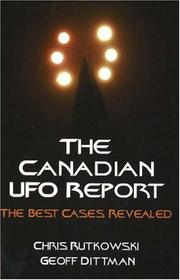
The Canadian UFO Report
Places the Manitoba sightings within the broader Canadian UFO reporting tradition.
eBay marketplace picks
Marketplace Samples
Example marketplace items related to this page. Use the search link to explore similar finds on eBay.
Endnotes
1.
Source: dundurn.com
Title: Charlie Red Star
Link:https://www.dundurn.com/books_/t22117/a9781459737808-charlie-red-star
Source snippet
Charlie Red Star - Dundurn...
2.
Source: canada.ca
Title: ‘s UFOs: The search for the unknown
Link:https://www.canada.ca/en/library-archives/collection/research-help/science-technology/ufos.html
Source snippet
Canada's UFOs: The search for the unknown - Canada.ca...
3.
Source: charlieredstar.com
Link:https://charlieredstar.com/
4.
Source: science.gc.ca
Title: Management of Public Reporting of Unidentified Aerial Phenomena in Canada
Link:https://science.gc.ca/site/science/en/office-chief-science-advisor/sky-canada-project/management-public-reporting-unidentified-aerial-phenomena-canada
5.
Source: army.mil
Link:https://www.army.mil/article/194445/smdc_history_safeguard_achieves_full_operational_capability
6.
Source: chrisrutkowski.substack.com
Title: Chris Rutkowski50 Years Ago: Canada’s “Summer of UFOs.”
Link:https://chrisrutkowski.substack.com/p/50-years-ago-canadas-summer-of-ufos
7.
Source: thebooktrail.com
Title: charlie red star
Link:https://www.thebooktrail.com/book-trails/charlie-red-star/
Source snippet
The Book TrailCharlie Red Star2 Jul 2017 — Charlie Redstar was a name given to some UFOs sighted across Manitoba in the summers of 1975 &...
8.
Source: bluebookfiles.org
Title: Project Blue Book Archive Canada Charlie Red Star 6 (unknown)
Link:https://bluebookfiles.org/doc/18266
Source snippet
Project Blue Book ArchiveCanada Charlie Red Star 6 (unknown) - Blue Book Archive...
9.
Source: epl.bibliocommons.com
Link:https://epl.bibliocommons.com/v2/record/S980C3028431
Source snippet
Red Star | Edmonton Public Library - BiblioCommons...
10.
Source: Wikipedia
Title: Stanley R. Mickelsen Safeguard Complex
Link:https://en.wikipedia.org/wiki/Stanley_R._Mickelsen_Safeguard_Complex
11.
Source: files.bluebookfiles.org
Link:https://files.bluebookfiles.org/pdfs/15149.pdf
12.
Source: files.bluebookfiles.org
Link:https://files.bluebookfiles.org/pdfs/15245.pdf
13.
Source: files.bluebookfiles.org
Link:https://files.bluebookfiles.org/pdfs/17589.pdf
14.
Source: youtube.com
Title: Canada’s Most SHOCKING True UFO Story
Link:https://www.youtube.com/watch?v=NRyM3ZLvA78
15.
Source: documents.theblackvault.com
Title: Canada FOIA Part 08 Pages 2101 2400
Link:https://documents.theblackvault.com/documents/ufos/canada/Canada%20-%20FOIA%20Part%2008%20-%20Pages%202101-2400.pdf
16.
Source: canadacommons.ca
Title: charlie red star
Link:https://canadacommons.ca/artifacts/1880923/charlie-red-star/2630359/
17.
Source: en.everybodywiki.com
Title: Charlie Redstar
Link:https://en.everybodywiki.com/Charlie_Redstar
18.
Source: believingthebizarre.com
Title: charlie red star
Link:https://believingthebizarre.com/charlie-red-star/
Additional References
19.
Source: youtube.com
Link:https://www.youtube.com/watch?v=4eG7Z5de1D0
Source snippet
UFOs, Charlie Red Star & Government Cover-ups: Grant Cameron...
20.
Source: youtube.com
Title: UFOs, Charlie Red Star & Government Cover-ups: Grant Cameron
Link:https://www.youtube.com/watch?v=bKiSHjXHUjs
Source snippet
How to Pilot UFOs and UAP with Grant Cameron...
21.
Source: threedifferentdirections.com
Link:https://www.threedifferentdirections.com/charlie-red-star.html
22.
Source: facebook.com
Link:https://www.facebook.com/crom2000/posts/here-is-a-clip-from-an-rcmp-intel-document-investigating-a-ufo-story-in-the-pitt/1288478239738415/
23.
Source: facebook.com
Link:https://www.facebook.com/LibraryArchives/posts/we-may-not-be-area-51-but-did-you-know-that-we-hold-a-vast-collection-of-ufo-fil/588151890149717/
24.
Source: facebook.com
Link:https://www.facebook.com/OscarZeroND/posts/the-end-of-safeguardoperations-continued-at-the-stanley-r-mickelsen-safeguard-co/1497809792346639/
25.
Source: instagram.com
Link:https://www.instagram.com/p/DK-OAY0PfFV/
26.
Source: brookings.edu
Link:https://www.brookings.edu/stanley-r-mickelson-safeguard-antiballistic-missile-complex/
27.
Source: recherche-collection-search.bac-lac.gc.ca
Link:https://recherche-collection-search.bac-lac.gc.ca/eng/home/record?IdNumber=134925&app=FonAndCol
28.
Source: reddit.com
Link:https://www.reddit.com/r/Manitoba/comments/v1wk3h/looking_for_some_research_help_is_there_anybody/
Topic Tree